This is kinda cool. At least they actually put my name in it!
Publisher's Weekly Online.

Tuesday, September 30, 2008

Friday, September 26, 2008
Mike Bara to Appear at Bay Area UFO Expo This Weekend
I’ll be appearing this weekend at the Bay Area UFO Expo in San Francisco. I’m giving a 45 minute lecture called “Artificial Structures on the Moon” on Saturday morning at 11:30 AM. If you are in the bay area drop by and I’ll sign your copy of Dark Mission, or just say hi.
Mike
Mike
Thursday, September 18, 2008
Extrasolar Planet Image Boosts Fission Model of Planetary Formation

As you may know, an image of the first confirmed extrasolar planet ever photographed was released on Monday of this week. Unlike previously photographed Exoplanets, this one appears to have a mass less than the 13 Jupiter masses which is the accepted limit for planetary designation. At only 8 Jupiter masses, the new planet is well under the mass that would place it in the Brown Dwarf category. Although the newly discovered planet is the right size to be a Brown Dwarf, this low mass implies that it is not.
University of Toronto researchers managed to snap a near infrared image of the gas giant planet orbiting more than 330 AU's from its parent star, 1RXS J160929.1-210524. Both objects are about 500 light years away.
This incredible orbital distance, which calculates to an orbit of some 6,000 years, is a direct contradiction to the accretion theory of planetary formation. The star itself is thought to be only about 5 million years old, the blink of eye in astrophysical terms, and the mere presence of the gas giant world creates all sorts of problems for the conventional model.
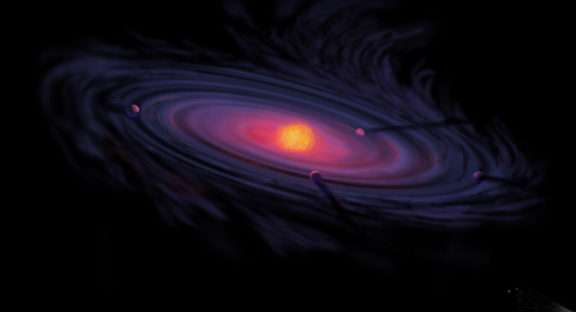
According to current theories, planets form from the remnants of stellar nebula's in so-called proto-planatary disks. However, according to current understanding of this theory, large gaseous planets (or planets of any kind) cannot form at this distance from stars because there is unlikely to be sufficient rocky material to form a mass large enough to collapse into a planet. Instead, scientists are now scrambling to explain how such a young, hot companion could have found itself so far from its parent star, and apparently in a stable orbit. The current theory du-jour is that it was somehow magically flung away from the star by an encounter with another star or due to collisions within the accretion disk. Unfortunately, there is no observational evidence or computer modeling to support this assertion. A better explanation is that the planetary accretion model is simply wrong.
Fortunately for the truly curious, there is a second competing theory of planetary formation that is supported by all of the existing observational evidence – including the discovery of the gas giant 330 AU from 1RXS J160929.1-210524. Some scientists, like Dr. Tom van Flandern, have long argued for the solar fission model of planetary formation.

Click here for video
In the fission model, once the rapidly coalescing solar nebula collapses and achieves sufficient density to begin nuclear fusion, it soon begins spinning so fast that the centrifugal forces become stronger than the gravitational field of the star, and solar material is flung out from the equatorial region of the young star. This material then spirals outward in twin pairs, forming first gas giant planets and then later terrestrial or rocky planets as the star’s angular momentum dissipates. This theory, unlike the solar accretion theory, neatly fits most, if not all, planetary observational data.
The solar fission theory would explain why all the planets are in the so-called plane of the ecliptic, why the planets hold 98% of the total solar system angular momentum but just a fraction (0.002) of the mass, why all of the planets have prograde orbits (matching the prograde spin of the sun), why other extrasolar gas giants seem to have formed so close to their parent stars, and why the planets in our own solar system seem to have formed in relatively similar pairs (Earth and Venus, Mercury and the Moon, Jupiter and Saturn, Uranus and Neptune).
There are naturally objections to the twin pair concept, notably that there is as yet little evidence that Mercury was once a moon of Venus, and that Jupiter is more massive than Saturn (in the twin pairs model it should be the other way around), and that Mars does not fit this model at all. However, in the Exploded Planet Hypothesis, all of this is easily explained, and not by some fairy-tale, move-the-goalposts band aid, but by actual observational evidence.
Our own Mars Tidal Model proves, with one simple correlative observation, that Mars has tidal bulges. The mere existence of these tidal bulges where none should exist is De facto proof that Mars is not a planet at all, but rather a moon of a much larger planet (designated “Planet V” in the EPH) that once existed near the orbit that Mars now occupies. It also implies - if the solar fission model is correct - that there is a missing “twin” of Planet V somewhere out there in the solar system.
OK, so where is it?
The EPH also builds on the idea of the old Titius-Bode law of planetary spacing. Roughly stated, TB says that each successive planet is about twice as far from the sun as the previous planet. Using the following chart, this all works out pretty well for the most part:

As you can see, until we get to Neptune, the TB Rule works almost perfectly. Only at the far reaches of the Solar system do we begin to see significant deviation. The following chart illustrates the point succinctly:

The only exceptions here are Ceres, which is not a planet but rather a prominent body in the asteroid belt between Mars and Jupiter, and Neptune, which seems pretty far out of the margin we would expect if TB was correct. Neptune is dealt with in van Flandern’s book Dark Matter, Missing Planets and New Comets, so we won’t get into that here. The main point is that according to the EPH, there are at least two missing planets in our solar system, Planet V, the parent planet of Mars, and Planet K, which once existed in the orbit now occupied by the asteroid belt. They would most likely have been terrestrial pairs, similar to Earth and Venus but with much larger masses and planetary radii.
So the asteroid belt turns out to be where Planet K once roamed, accounting for the multitude of bodies in that rocky ring of planetesimals. The EPH also explains one other enduring mystery of the solar system – why Mars and Mercury have the two most eccentric orbits of all the “planets.”
If, as the EPH postulates, Mars was once a moon of Planet V and Mercury a moon of Venus, then it would stand to reason that they, having been recently ejected some 65 MYA, would have non-circular or “eccentric” orbits. This is in fact exactly what we see. Mercury (0.206) and Mars (0.093) have by far the most elliptical orbits of any of the major planetary bodies.
So what does all this have to do with the newly discovered gas giant around 1RXS J160929.1-210524? Well, it seems obvious that we are seeing, in near real time, the birth of a new planet in accordance with the fission model. It has been ejected from its parent star a relatively short time ago, and is already some 330 AU from its birth place. Not only does this tell us that planets can exist that far from a parent star (which greatly increases the likelihood that a Planet X exists in our own solar system), but it also explains how massive gas giants can be found so close to their parent stars, as has been observed in some other cases. It’s obvious that these close-in gassy planets have only been recently excreted from their parent stars.

It should be a fairly easy task to calculate its rate of recession from 1RXS J160929.1-210524 (let’s just call it 1RXS from now on, shall we?) - if it is receding at all - and determine (based on its luminosity) how long it has been traveling away from 1RXS. That will give us a timetable for about how long it should take a star of similar mass and composition to start spitting out planets and give us a fighting chance of training our cameras on another candidate star and perhaps catch it in the act of spewing out its first planet.
And wouldn’t that be a picture?
Wednesday, September 17, 2008


Tuesday, September 16, 2008
Extraordinary!

I couldn't believe it when I saw it, the first real proof that there are other worlds orbiting distant stars. University of Toronto researchers managed to snap an image of a gas giant planet orbiting more than 330 AU's from it's parent star, 1RXS J160929.1-210524. Both objects are about 500 light years away.
There are tons of implications of this discovery, but for the moment, I just want to sit back and wonder at something I never thought I would ever see.
Another world. In a completely different star system.
Amazing.
Saturday, September 13, 2008
Quick Blogging Update
You guys may have noticed that the pace has slowed here in the last few weeks. There are several reasons for this, most notably that I am spending more time on my NFL Football Blog and a new political Blog that I felt compelled to start. I'll be posting to that one with some frequency, at least through the election cycle. I'm also working on the last 5,000 words for a new book I'm doing solo, and then I have some more writing to do for another project with Richard. These have hard deadlines of October 1st and November 1st respectively, and I have a few other projects which deserve my attention as well. And there is always my day job as a card carrying member of the military industrial complex.
The point is, I'm going to back off the Dark Mission Blog for a while. I am by no means abandoning this blog, I'm just going to be adding new stuff with less frequency until I can clear some other items from my to do list. There are a couple of upcoming posts, including another research paper documenting a Hyperdimensional physics effect, and some thoughts on the rumor that NASA may be preparing to release "proof" of life on Mars. These will likely appear next week at some point, and as always I'm ready to post on any breaking news.
I just wanted to let you guys know what was going on.
Mike
The point is, I'm going to back off the Dark Mission Blog for a while. I am by no means abandoning this blog, I'm just going to be adding new stuff with less frequency until I can clear some other items from my to do list. There are a couple of upcoming posts, including another research paper documenting a Hyperdimensional physics effect, and some thoughts on the rumor that NASA may be preparing to release "proof" of life on Mars. These will likely appear next week at some point, and as always I'm ready to post on any breaking news.
I just wanted to let you guys know what was going on.
Mike
Monday, September 8, 2008
New Cover for Secret and Suppressed II

Publisher Feral House has released the new cover art for Secret and Suppressed II, the new collection of essays from editor Adam Parfrey. You can pre-order the book (which contains my 7,500 word essay on Dark Mission) from Amazon.com.
Tuesday, August 26, 2008
Former NASA Scientist Alleges Satellite Shoot down Unnecessary
See the Wired Magazine article here: http://blog.wired.com/defense/2008/08/former-nasa-sci.html
And the original article on this story at Enterprisemission.com.
And the original article on this story at Enterprisemission.com.
Tuesday, August 19, 2008
Central Coast UFO Symposium
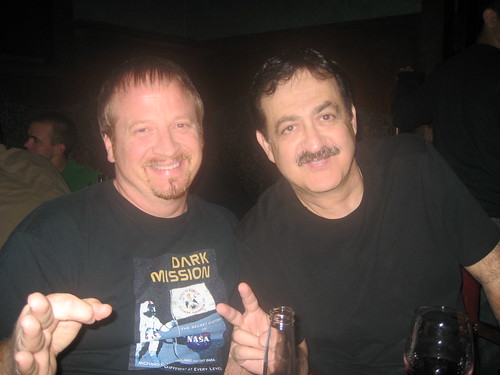
I went to the Central Coast UFO Symposium this weeend. There are pics on my Flickr site and a blog on my MySpace site.
MB
Sunday, August 10, 2008
"Dr. Chandra" Says William Shatner Was Right...
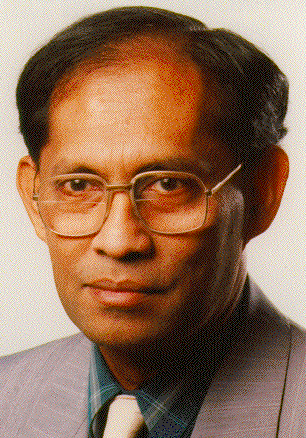
Astrobiologist Chandra Wickramasinghe, who was the inspiration for a character in Arthur C. Clarke's "2010 - Odyssey Two," has stated in a recent interview that not only is there "contemporary life" on Mars, but he asserts that NASA is withholding the information for political reasons. He also defends the work of Dr. Gil Levin on the original Viking Labeled Release Experiment, which came back positive for life signs in 1976. NASA has subsequently consistently denied that Levin's results were legitimate, and has taken every opportunity in the ensuing decades to minimize his results.

All of this will of course be familiar to readers of Dark Mission, which lays out virtually the same case in its heavily footnoted 550 pages. The only significant area of disagreement between our premise and Dr. Wickramasinghe’s assessment is that he still clings to the “honest but stupid” model of NASA’s behavior, as opposed to our contention that NASA is operating on a “timed release aspirin” model dictated by the recommendations of the Brookings Report.
A full story on the interview can be found on the NDTV.com science and technology site.
The William Shatner Post
Wednesday, August 6, 2008
New Research Reinforces Key Aspects of Hyperdimensional Physics

A new paper by a pair of Australian astronomers has provided a flat-out, indisputable confirmation of the Hoagland\Torun Hyperdimensional Physics model first proposed in their 1989 paper, “The Message of Cydonia.” The new paper, titled “Does a Spin–Orbit Coupling Between the Sun and the Jovian Planets Govern the Solar Cycle?” points out a resonant, synchronized relationship between the Sun’s periodic peak sunspot cycles and the orbital positions of the Jovian planets, Jupiter and Saturn. Careful readers of Dark Mission will note that this exact relationship is both implicitly and explicitly predicted in Chapter 2 of our book.
While the mechanical cause of the increased sunspot activity is reasonably well understood (it’s caused by the sun’s rotation), the driving force linking this spin and the sunspot cycle has remained a mystery. According to Dr. Ian Wilson of the University of Southern Queensland, which published the new research, observations by solar astronomers have concluded that the equatorial regions of the sun rotate slightly more rapidly than the polar regions. This differential rotation winds up the sun’s magnetic field lines (which stretch between the two poles) like a set of rubber bands. Eventually, the field lines work their way to the surface of the sun because the concentrated magnetic flux is more buoyant than the surrounding solar surface. This subsequently causes sunspots, solar flares and coronal mass ejections, which tend to cluster around the tetrahedral 19.5° latitude at the peak of this cycle. This peak is called “solar maximum” because all the visible spots, flares, etc. are most numerous at this time, after which the magnetic poles reverse and the cycle begins again.

There has historically been a recognized connection between the frequency of sunspot activity (the total number of spots) and the movement of the sun in relation to solar system's “barycentre,” or center of mass. This is driven primarily by the combined gravitational forces of Jupiter and Saturn, and to a far lesser extent, the other planets. But the big problem is that there is no conventional explanation for exactly how this influence occurs.
"There are really only two possible interactions, and neither of them is feasible," Dr. Wilson said in an interview. "Tidal forces are too tiny. They can only produce a movement of about a millimeter on the surface of the sun.
"The alternative, that the sun's motion about the centre of mass should be able to generate internal motions within the sun, violates Einstein's equivalence principle [emphasis added]"
What separates this new research from previous interpretations is the observation that the relative positions of Jupiter and Saturn somehow affect this cyclical energy variation. To quote from an article about Wilson et al’s paper appearing on the Australian ABC science website:
“The authors believe the tiny gravitational tugs of Jupiter and Saturn speed up or slow down the sun's orbital motion about the centre-of-mass, when they are aligned or separated by an angular distance of 90 degrees.
“They say that when the sun's orbital motion changes, so too does its equatorial rotation rate, which provides strong circumstantial evidence that there is a spin-orbit coupling mechanism operating between Jupiter and Saturn and the sun.
“The authors propose that this spin-orbit coupling takes the form of a 9:8 resonance, with the 179 year alignment cycle of the Jovian planets being equal to nine alignments of Jupiter and Saturn and eight 22-year Hale cycles.
“The extent to which Jupiter and Saturn affect the sun's motion may impact on the strength of sunspot activity throughout its solar cycle.
But Wilson is cautious.
"’It is one thing to show an association and quite another to show cause and effect. We have to be very careful, but we will know in a few years,"
Of course, the reality is that as long as solar astronomers keep searching for a conventional “gravitational” effect for this resonance synchronization, they will never fully understand what is causing the differential rotation and the consequent variable excess energy from the sun. In the conventional view, it is mass, and therefore gravity, which is the only viable influence on solar energy output and motion.
But in the Hyperdimensional Physics model, “the tail wags the dog” -- in the form of angular momentum.
It is an undeniable fact that Jupiter and Saturn -- which possess only a tiny fraction the solar system’s total mass compared to the sun – are, in fact, a huge influence on the sun itself (and all of the other planets as a consequence). This is because they conversely possess most (almost 99%) of the solar system’s total bulk angular momentum.
In the Hyperdimensional model, it is this angular momentum -- mainly from these two massive planets, transmitted through the “Hyperdimensional aether” -- which ultimately causes the sun’s differential rotation.
To quote directly from Dark Mission, Chapter 2:
“Changes in one gravitationally-connected system on a large scale, like the planetary scale of a solar system, can therefore have an instantaneous, measurable effect on other bodies in the same system -- providing there is a "resonance condition" (a matched connection) between those two objects via hyperspace. Thus, the Hyperdimensional Model argues that everything, even widely separated three-space objects like remote planets, are ultimately connected through this four-space interaction; meaning that a cause in one place (like Jupiter) can have an effect in another (like the sun) -- without any measurable 3D force (such as an electromagnetic wave) having measurably traversed the three-space distance in between."
In this classical Einsteinian view of physics, there is no "aether”—as it was called in Maxwell’s day—to carry electromagnetic radiation's transverse waves across the vacuum. In the hyperdimensional model, the aether is back -- as the actual transformation medium between the higher spatial realities and our dimension – through something called the “torsion field…”
This whole notion, that the changing [orbital] configuration of a planets (or star’s) system members relative to the “primary” can have an effect on its total energy output, is revolutionary to current thinking, but hardly without precedent.
In the 1940s, the Radio Corporation of America (RCA) hired John Nelson, a young electrical engineer, in an effort to improve the reliability of short-wave radio communications around Earth. Such radio transmissions had been observed to be more reliable in the "lulls" in between solar activity associated with "peak" sunspot years.
To his surprise, Nelson soon specifically correlated this rising and falling radio interference with not only the sunspot cycle, but with the motions of the major planets of the solar system. He found, to his increasing astonishment, a very repeatable—in essence, astrological—correlation between the inexorable orbits of all the planets (but especially, Jupiter, Saturn, Uranus and Neptune, which hold essentially all the solar system's known angular momentum) and major radio-disturbing eruptions on the sun.
The hyperdimensional model finally provides a comprehensive theoretical explanation—a "linking mechanism"—for these (to a lot of astronomers) still embarrassing decades-old RCA observations. For, in essence, what John Nelson had rediscovered was nothing short of ”hyperdimensional astrology"—the ultimate, very ancient, now highly demonstrable angular momentum foundations behind the real influences of the sun and planets on our lives. Nelson also "rediscovered" something else:
"It is worthy of note that in 1948, when Jupiter and Saturn were spaced by 120º, and solar activity was at a maximum, radio signals averaged of far higher quality for the year than in 1951 with Jupiter and Saturn at 180º and a considerable decline in solar activity. In other words, the average quality curve of radio signals followed the cycle curve between Jupiter and Saturn rather than the sunspot curve...”
These decades-old observations are very telling ... not only confirming Jupiter and Saturn as the primary drivers behind the sun's known cycle of activity (in the hyperdimensional model), but strongly implying an additional direct effect of their changing angular relationship on the electrical properties of Earth's ionosphere. This, of course, is totally consistent with these changing planetary geometries affecting not just the sun, but the other planets simultaneously as well, just as "conventional" astrologers have claimed, via Maxwell's "changing scalar potentials.”
At this point, then, only the Hyperdimensional Theory:
1. Points to the deepest implications of the simple astronomical fact that the tail “does wag the dog" -- that the planets in this Physics are fully capable of exerting a determinant influence on the sun – and on each other -- through their disproportionate ratio of total solar system angular momentum: over 100 to 1, in the (known) planets' favor.
2. Possesses the precise physical mechanism -- via Maxwell's "changing quaternion scalar potentials" (also known now as the “torsion spin field”) -- accounting for this anomalous planetary angular momentum influence.
3. Has already publicly identified, at the United Nations in 1992, a blatant geometric clue to this entire hyperdimensional solar process: the maximum sunspot numbers (those large, relatively cool, rotating vortices appearing on the solar surface), rising, falling and methodically changing latitude, during the course of the familiar twenty-two-year solar cycle—and peaking every half-cycle (around eleven years), at the solar latitude of 19.5º.
Don’t you just love it when a good theory comes together so elegantly?
Make no mistake, if this Wilson et al. paper is widely accepted, somebody will eventually concoct a tenuous conventional explanation to rationalize the observations. But that theory will hold no more weight than the absurd “radiation degradation” idea that was floated about a few years ago to explain Iapetus 60,000-foot-high equatorial wall.
At some point, modern physicists will just have to face the unpleasant reality – Einstein was wrong about the aether; and Maxwell’s original “hyperdimensional physics/aether model” was right.
Further References: The John Nelson RCA Paper
MB\RCH
Tuesday, August 5, 2008
Essay by Mike Bara to be Included in New Anthology

Secret and Suppressed II, a new anthology edited by Feral House publisher Adam Parfrey, will inlcude an essay written by Dark Mission co-author Mike Bara. The original Secret and Suppressed was a highly influential work, and Feral House expects the new version to be just as well recieved.
Look for it in book stores this fall. Pre-orders are currently being taken on Amazon.com.
Subscribe to:
Posts (Atom)