 |
| www.contactinthedesert.com |

Monday, June 23, 2014
Join Me at Contact in the Desert, August 8-11, 2014

Thursday, June 19, 2014
Yet More Research Supports Key Prediction of Hypersimensional Physics Model
 |
| The Choice |
As you'll recall in my second book The Choice, I discussed the theory of multi-dimensional or Hyper-dimensional physics. One of the key aspects of the theory was the assertion that spin energy, or total system angular momentum, to use the astronomical term, had a direct linkage to a bodies total luminosity. In other words, the more energetically an object and it's satellites spun, the brighter it was in all ranges of the light spectrum (not just visible light). This rule, adopted from Schuster's hypothesis, seemed to fit quite well with all of the observable planets (and their moons) in the solar system.
 |
|
Luminosity vs. spin energy. One
or two undiscovered planets beyond the orbit of Neptune would move the Sun to
the right and place it on the predicted curve along with all the major planets.
|
Except for one problem. The Sun itself, which is the centerpiece of the solar system, was far off the graph, meaning it was much too bright to fit the model. This then led to a key implication and prediction of the Hyperdimensional Physics model: i.e., there is at least one Jupiter mass planet or two smaller planets in far distant orbits that have yet to be discovered. Fulfillment of this prediction is important to this aspect of the Hyperdimensional theory, and would help show that conventional models of the solar system in which the only linking force between the planets is gravity are wrong.Successful prediction is also a key element of the scientific method. Without it, you cannot truly say that you follow the scientific method. Since The Choice came out in 2010, there have been a number of discoveries that have thrown the question of whether there are large and far away bodies in the solar system into a issue of considerable debate. But as far back as 1982, NASA seemed convinced these objects existed, and was actively searching for them.
 |
| Illustration from 1982 Science Digest article showing how Pioneer's 10 and 11 could be used to search for "Planet X." |
In a 1982
Science Digest Magazine article, Dr. J. Allen Hynek, a well-respected astronomer and
sometimes UFO investigator, wrote about the search for "Planet X" and how
Pioneers 10 and 11 could be used to search for them. In the article, he included a
diagram that showed the two suspected planet's positions relative to the Pioneers’ paths and the
known solar system. The first body was shown to be 4-7 billion miles out, and
was labeled the “Tenth planet” (or "Planet X)." The second object was labeled “Brown Dwarf?” The
brown dwarf was listed as being 50 billion miles out, or about 550 Astronomical Units, an astonishing distance which was considered so far out that gravitational tethering to the sun was widely regarded as impossible.As Pioneers 10 and 11 reached the outer limits of the solar system, NASA's idea was to use them to search for the "Planet X's" (I like to call them Nemesis and Nibiru) by looking for the subtle gravitational tug these theoretical bodies would exert upon the spacecraft. They found exactly that.
As early as 1980, when the twin spacecraft were at a distance of about 20 AU's (1.859 billion miles), NASA technicians noted a significant deceleration of both spacecraft which they could not account for by known physical forces. Over the years, various explanations for the "Pioneer Effect" were touted, but none of them completely held up under scrutiny. The gravitational tug of an unseen body (or bodies) remained a viable explanation for the anomalous deceleration. Other spacecraft, like the Voyagers 1 and 2, and the Galileo and Ulysses probes, have shown the same effect but the accuracy of these observations is debated.
The question of the existence of Nemesis and Nibiru was brought into sharper focus with the launch of NASA's WISE spacecraft which was designed to search for deep objects (like Brown Dwarfs) in the outer reaches of the solar system. As I documented in an earlier post, the initial results were claimed by NASA to show there were no "Planet X's" out there. However, two separate teams of researchers had inconsistent results with the same database, calling into question whether or not NASA had simply missed one or more large solar system objects in their study.
A new study using the so-called "Dark Energy Camera" controlled by the Carnegie Institution for Science discovered a new dwarf planet, "2012 VP113," at the far reaches of the solar system. Like Sedna before it, 2012 VP113 has a very exotic orbit that implies it is being "shepherded" by another, far more massive object. Taken together, the orbits of Sedna and 2012 VP113 indicate that Planet X (or multiple "Planet X's") are in fact out there, but are just not detectable by instruments like WISE.
Now, there are even more studies that indicate the same thing. A new paper recently submitted to Cornell University Press argues that not only is the previous work by the Carnegie scientists correct, but there is a second and probably far more massive body lurking even deeper in the outer solar system.
The paper, by Carlos and Raul de la Fuente Marcos at the Complutense University of Madrid, is entitled "Extreme trans-Neptunian objects and the Kozai mechanism: signalling the presence of trans-Plutonian planets." It shows that there is at least one "Super Earth" sized planet at about 200 AUs (18.5 billion miles) distance from the sun, exerting a pull on dozens of smaller "Trans Neptunian Objects" like Sedna and 2012 VP113. This planet, with a mass as great as Saturn, is also locked in a resonant orbit with another even larger and more massive object at 250 AUs (23.2 billion miles). Both of these objects fit the description of Nemesis and Nibiru in the Hyperdimensional model very well, even though the distances fall between the 5-50 billion mile range NASA had predicted. Only when these objects are actually found can their angular momentum be established and their impact on the prediction be determined. According to Carlos de la Fuente Marcos, that will not be an easy task, since the bodies are large, dim, cold and very slow moving. In fact, given the current state of technology, "It's not at all surprising that they haven't been found yet," he said.
Clearly, these two new papers show that not only is data from WISE not entirely reliable, but that NASA's declaration to the effect that "there is no Planet X" was not only premature, but flatly wrong.
Just like the harping critics of the Hyperdimensional Physics theory...
Articles:
http://www.newscientist.com/article/dn25711-two-giant-planets-may-cruise-unseen-beyond-pluto.html#.U5j6mpPn-Ul
http://arxiv.org/abs/1406.0715
Join me at Contact in the Desert in August!
Monday, June 9, 2014
The Glass Tubes of Mars Revisited
A couple of days ago I stirred up a bit of a pot by suggesting I'd mop up the floor with the Great Neil deGrasse Tyson in a debate. This all came from a simple meme posting to my Facebook page, responding to one of his latest silly quotes.

The meme was only meant to point out that something isn't true just because people like Neil deGrasse Tyson say it is. In fact, most of what "scientists" have believed to be true at any given snapshot in time has eventually been proven to be false as more information has developed and new discoveries and observations have been made. Somewhere along the line, I guess this got passed around Facebook and some other social media sites and this led some people to respond by attacking me, and saying that I'd get creamed in a debate with the Great NDGT because, well, I'm just that dumb. I responded to one them thusly:
"Trust me, neither you nor NDGT would like to see me debate him. He'd get beat worse than the Broncos in the Super Bowl. And BTW, science is not Truth. Scientific materialism is simply another worldview no different than the religious dogmas it and people like him seek to ridicule."
Quite to my surprise, this response actually stirred up something of a reaction. I guess some of my more psychopathic critics have nothing better to do than monitor my social media pages all day. Anyway, in one Facebook forum, another user sought to disparage me and my Dark Mission co-author Richard Hoagland by claiming that "we" had been proven wrong yet again. He provided a link to a blog by somebody named Lori Fenton, who I guess is some kind of low-level research scientist somewhere.
Anyway, the blog post is titled "Debunking Hoagland’s “Glass Worms” with HiRISE," and claims the following:
"Several years ago, a guy named Richard Hoagland claimed that some parallel linear features on Mars looked like the ridges of a transparent earthworm, calling these things “glass worms”. Phil Plait debunked it nicely, but Hoagland stood his ground. He hasn’t said much about them lately, has he? Here’s why. New images show that, as scientists originally thought, these are nothing more than windblown ripples in the floors of channels, just like the many thousands of ripples seen all over Mars. Go science!" (HiRISE ESP_035634_2160, NASA/JPL/Univ. of Arizona)
At first, I was excited, because it would be nice to get a good HiRISE look at the "Glass Tunnel" Hoagland had first noted on MGS image M0-400291. To my knowledge, there hasn't been another good image taken of the area since that one. Maybe that's got more to do with why he's had no more to say on the subject than her "new image."
Of course, in her haste to attack Hoagland, she manages to get pretty much all of it wrong. I was actually not surprised to discover that this dingbat's image not only didn't show Hoagland's Glass Tube, it was actually not taken anywhere near the image in question. Add to that the fact that Hoagland never referred to them as "Glass Worms" (it was Arthur C. Clarke who called them that) and you've pretty much got the trifecta of stupidity by the blogger in question. When a reader called her out on the fact that her image, which she claimed "proved" Hoagland wrong and which she led her readers to believe was the same object--was not even of the same area of Mars, she responded by saying "No, it’s not the same place. It wouldn’t change anything, though."
So I guess this is a good measure of how high the bar is set in the mainstream science community. Call out a NASA opponent using a false comparison and then claim you are the one employing the "scientific method."
Um, right.
Maybe 43-8 is a little less optimistic than I should be...
UPDATE:
After some prodding by a reader, Ms. Fenton finally looked up the MRO image for the (in)famous "Glass Tube." She found one, ESP_013137_2190, which it turns out is about the same resolution as Hoagland's original MGS image M0-400291. More importantly, contrary to what Phil "Dr. Phil" Plait claimed in his attack piece, the tubular impression is reinforced by the new image, rather than debunked. His argument comes down to one thing; the tube is not convex, it's concave. Unfortunately the images he presents in his hit piece to support this show it to be convex, as Hoagland has asserted. The new image shows the same thing.
 Plait also attempts to explain -- without any supporting evidence -- the brilliant specular reflection now visible in both images as a "contrast artifact," which it most demonstrably is not. In both images, which are taken under almost identical lighting conditions, the bulbous structure at left side of the tube is brilliantly reflective. Simple rocks and sand cannot produce such a reflection. Only glass or possibly water ice can do so. Either way, the explanation of this as a simple dune train is falsified by the new image, which is clearly convex and supports Hoagland's original thesis.

The meme was only meant to point out that something isn't true just because people like Neil deGrasse Tyson say it is. In fact, most of what "scientists" have believed to be true at any given snapshot in time has eventually been proven to be false as more information has developed and new discoveries and observations have been made. Somewhere along the line, I guess this got passed around Facebook and some other social media sites and this led some people to respond by attacking me, and saying that I'd get creamed in a debate with the Great NDGT because, well, I'm just that dumb. I responded to one them thusly:
"Trust me, neither you nor NDGT would like to see me debate him. He'd get beat worse than the Broncos in the Super Bowl. And BTW, science is not Truth. Scientific materialism is simply another worldview no different than the religious dogmas it and people like him seek to ridicule."
Quite to my surprise, this response actually stirred up something of a reaction. I guess some of my more psychopathic critics have nothing better to do than monitor my social media pages all day. Anyway, in one Facebook forum, another user sought to disparage me and my Dark Mission co-author Richard Hoagland by claiming that "we" had been proven wrong yet again. He provided a link to a blog by somebody named Lori Fenton, who I guess is some kind of low-level research scientist somewhere.
Anyway, the blog post is titled "Debunking Hoagland’s “Glass Worms” with HiRISE," and claims the following:
"Several years ago, a guy named Richard Hoagland claimed that some parallel linear features on Mars looked like the ridges of a transparent earthworm, calling these things “glass worms”. Phil Plait debunked it nicely, but Hoagland stood his ground. He hasn’t said much about them lately, has he? Here’s why. New images show that, as scientists originally thought, these are nothing more than windblown ripples in the floors of channels, just like the many thousands of ripples seen all over Mars. Go science!" (HiRISE ESP_035634_2160, NASA/JPL/Univ. of Arizona)
At first, I was excited, because it would be nice to get a good HiRISE look at the "Glass Tunnel" Hoagland had first noted on MGS image M0-400291. To my knowledge, there hasn't been another good image taken of the area since that one. Maybe that's got more to do with why he's had no more to say on the subject than her "new image."
 |
| "Glass Tubes" |
Of course, in her haste to attack Hoagland, she manages to get pretty much all of it wrong. I was actually not surprised to discover that this dingbat's image not only didn't show Hoagland's Glass Tube, it was actually not taken anywhere near the image in question. Add to that the fact that Hoagland never referred to them as "Glass Worms" (it was Arthur C. Clarke who called them that) and you've pretty much got the trifecta of stupidity by the blogger in question. When a reader called her out on the fact that her image, which she claimed "proved" Hoagland wrong and which she led her readers to believe was the same object--was not even of the same area of Mars, she responded by saying "No, it’s not the same place. It wouldn’t change anything, though."
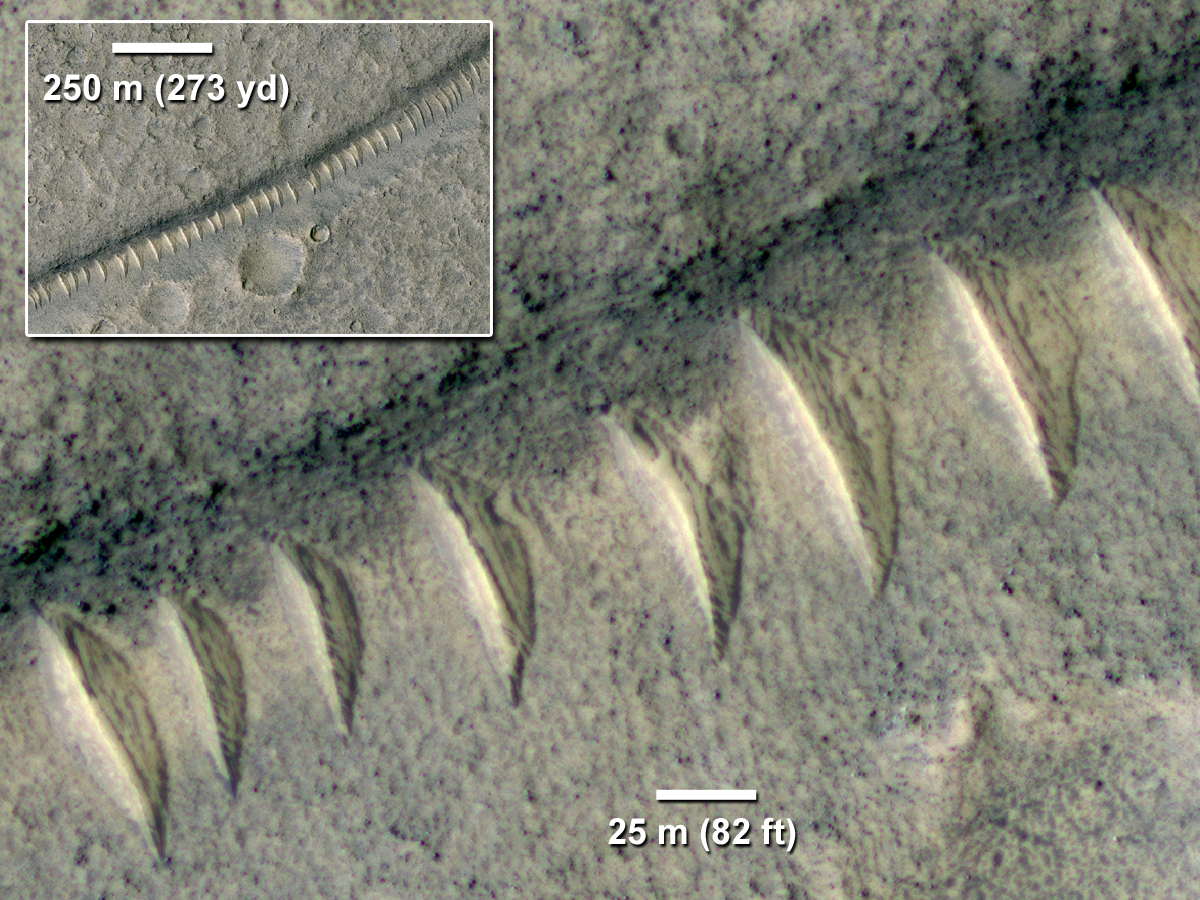 |
| Not "Glass Tubes." |
So I guess this is a good measure of how high the bar is set in the mainstream science community. Call out a NASA opponent using a false comparison and then claim you are the one employing the "scientific method."
Um, right.
Maybe 43-8 is a little less optimistic than I should be...
UPDATE:
After some prodding by a reader, Ms. Fenton finally looked up the MRO image for the (in)famous "Glass Tube." She found one, ESP_013137_2190, which it turns out is about the same resolution as Hoagland's original MGS image M0-400291. More importantly, contrary to what Phil "Dr. Phil" Plait claimed in his attack piece, the tubular impression is reinforced by the new image, rather than debunked. His argument comes down to one thing; the tube is not convex, it's concave. Unfortunately the images he presents in his hit piece to support this show it to be convex, as Hoagland has asserted. The new image shows the same thing.
Sand dunes with supports at 90 degree angles?
I'd also love to see the explanation for "sand dunes" that connect with support struts at 90 degree angles to the "dunes," but I kinda doubt I'll get satisfaction on that one either. At least, not from the mainstream crowd.
But I'm open. Send me the pictures anytime guys.
UPDATE-UPDATE:
Just FYI, here is the analysis done by the late Dr. Tom van Flandern on the Glass Tubes phenomenon:
"Glassy tubes" on Mars are sand dunes?
UPDATE-UPDATE-UPDATE:
I was just pointed to this posting by one "Johnny Danger" exposing the whole sordid history of the Glass Tubes debate with NASA. As usual, NASA's behavior is duplicitous, at the least:
http://palermoproject.com/lowell2004/legacy8.htm
UPDATE-UPDATE:
Just FYI, here is the analysis done by the late Dr. Tom van Flandern on the Glass Tubes phenomenon:
"Glassy tubes" on Mars are sand dunes?
UPDATE-UPDATE-UPDATE:
I was just pointed to this posting by one "Johnny Danger" exposing the whole sordid history of the Glass Tubes debate with NASA. As usual, NASA's behavior is duplicitous, at the least:
http://palermoproject.com/lowell2004/legacy8.htm
Thursday, June 5, 2014
Another "Uncovering Aliens" Marathon today on Destination America!
 |
| Derrell Sims, Steven Jones, Maureen Elsberry and me from Uncovering Aliens |
Link: Destination America TV Schedule
Thursday, May 29, 2014
Win a pair of free passes for Contact in the Desert, August 8-11, 2014!
Follow the link below to enter a free contest to win 2 free passes to Contact in the Desert in Joshua Tree, California, August 8-11, 2014!
Win A pair of Passes to CONTACT in the DESERT from Mike Bara
A weekend of exploration into ancient astronauts, extraterrestrial life, human origins, crop circles, UFO sightings, contact experiences and the need to know. View the Perseid Meteor Shower through the clear desert sky. 8-11 August 2014 in Joshua Tree, California. For complete conference info, visit CONTACTintheDESERT.com.
I'll be previewing all the incredible new images from latest book, "Ancient Aliens on Mars II," so you don't want to miss it! CITD is really a great conference with a All-Star list of speakers from the UFO community, including George Noory, Giorgio A. Tsoukalos, Erich von Däniken, David Wilcock, Jason Martell, Jim Marrs, Linda Moulton Howe, Stephen Bassett and many more! This promises to be the best UFO conference in the world!
 |
| contactinthedesert.com/mikebara |
FINE PRINT
Enter to win a pair of passes to CONTACT in the DESERT. Earn one additional entry for every Facebook friend who enters from a link you share. All lectures and panels included with a full weekend pass. Workshops, intensives, tours, special luncheons and meal plans are sold separately. Winner will be notified by email and/or announced on our Facebook page. For more information about the conference, visit CONTACTintheDESERT.com.
Monday, May 19, 2014
"Uncovering Aliens" Marathon on Animal Planet's "Monster Week" Friday and Saturday

There will be 2 marathon showings of my new reality show "Uncovering Aliens" on the Animal Planet network's Monster Week this Friday night and Saturday morning. The first group of showings of all 4 episodes begins at 4PM Eastern and Pacific with Episode 1, "Black Ops Conspiracy" and runs through 7PM's reshowing of "Alien Invasion." 3 of the episodes then re-run from 3AM to 5AM on Saturday morning.
Even if you've already seen all 4 first-run episodes on other networks, at least DVR record the episodes and then run them when you are not otherwise watching TV. DVR recordings and viewings count in the ratings numbers too so don't forget!
Assuming we get the numbers the network is looking for, we should get final clearance to shoot more episodes quickly thereafter.
The complete schedule for Monster Week is here:
http://www.animalplanet.com/tv-shows/tv-schedule.htm
Monday, April 28, 2014
NASA's Latest Absurd Explanation for Iapetus' Equatorial Ring.
Dr. Joe Farrell explains it better than I ever could... so why not let him?
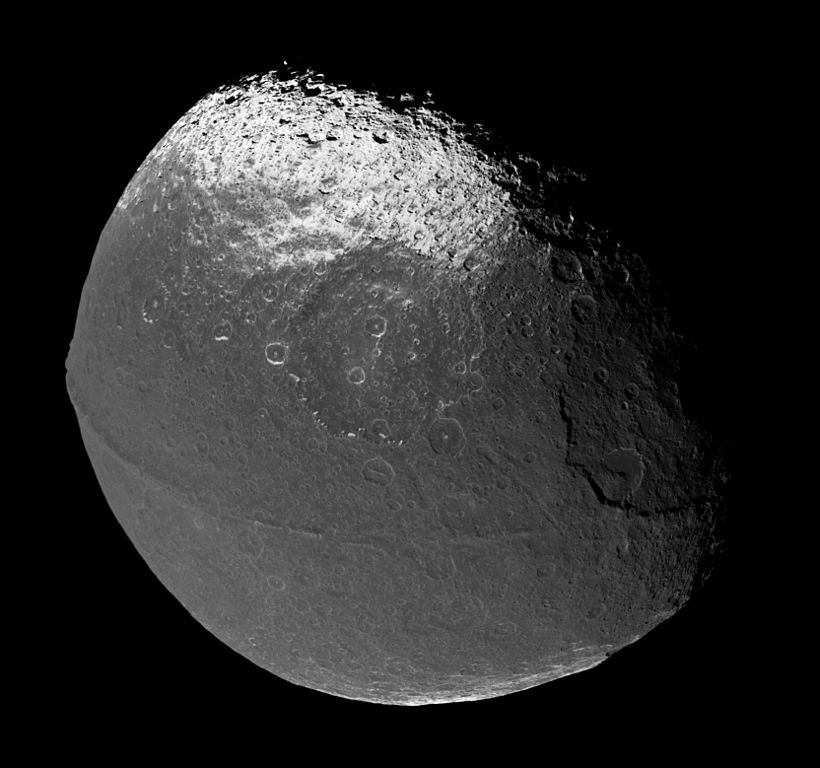 |
| Saturn's Moon Iapetus |
Dr. Joe Farrell: YOU CAN RELAX NOW: THAT MYSTERIOUS EQUATORIAL RIDGE ON IAPETUS IS FINALLY “EXPLAINED…”Tuesday, April 15, 2014
Dynamic Torsion at Work
A neat little animation which shows the true motion of the solar system, as outlined in my 2nd book, The Choice. The driving mechanism is the unacknowledged "5th force" in the Universe, Dynamic Torsion.
Post by Nassim Haramein.
Thursday, April 10, 2014
Images for Tonight's Coast to Coast AM Appearance 4/10/2014
 |
| Close-up of April 2nd image |
 |
| Enhancement of April 2nd image |
 |
| Enhancement of April 3rd image |
 |
| Animation of April 2nd image |
 |
| Left and right NAVCAM images (April 2nd) |
 |
| Artifact |
 |
The "Train Tracks" |

Wednesday, March 26, 2014
New Discovery Points to Large Planet at Edge of the Solar System


This spin energy deficit could be explained by the presence of these as yet undiscovered planets at the far reaches of the solar system. If they contained the extra angular momentum that was driving the Sun, then the prediction would be fulfilled and the model confirmed. If not, it could be plausibly though not decisively falsified.
The prediction seemed to take a blow last month when an initial study of data returned by NASA's Wide-Field Infrared Survey Explorer (WISE) instrument indicated no large planets or small stars in the nether regions of the solar system. However, a 2nd study found objects the first did not, and vice-versa, so there were still questions about the completeness of the data. And of course there are always questions about the integrity of the data that NASA releases. But still, NASA declared the idea of "Planet X" or "Nemesis" all but dead based on the WISE survey.
 |
| 2012 VP113, a dwarf planet, is imaged using red, green and blue filters by Dark Energy Camera, which is installed on a 4-meter telescope at the Cerro Tololo Inter-American Observatory in Chile.
Now however, a new study using the so-called "Dark Energy Camera" controlled by the Carnegie Institution for Science has discovered a new dwarf planet, "2012 VP113," at the far reaches of the solar system. Like Sedna before it, 2012 VP113 has a very exotic orbit that implies it is being "shepherded" by another, far more massive object. Taken together, the orbits of Sedna and 2012 VP113 indicate that Planet X (or multiple "Planet X's") are in fact out there, but are just not detectable by instruments like WISE.

|
The scientists were very clear in their declarations that the Planet X debate is far from closed. "Some of these inner Oort Cloud objects could rival the size of Mars or even Earth," Dr. Scott Sheppard of the Carnegie Institution for Science said in a statement. "This is because many of the inner Oort Cloud objects are so distant that even very large ones would be too faint to detect with current technology. If you took a Super Earth and put it a few hundred astronomical units out, the gravity could shepherd Sedna and this new object into the orbits they have," said Sheppard.
At a minimum, the object would be the size of a "Super Earth," a massive rocky terrestrial world larger and more massive than Earth, but Sheppard also emphasized that the planet could be even larger and more massive than that.
So, it would seem that Planet X lives after all...
Friday, March 14, 2014
Europa and the Hoagland Eccentricity
Since there are a bunch of Europa articles springing up in recent days, I thought I'd repost this just for historical clarification:

by Jay Ingram
The Toronto
Star
Sunday, March 9, 1997
Context Section - Page B8
Science
At the
annual meeting of the American Association for the Advancement of Science a
couple of weeks ago, scientists discussed the possibility that life might have
- and might still exist on Jupiter's moon Europa.
Europa is by
any measure a bizarre solar system object. Its surface appears to be a huge
badly flooded skating rink at the end of a busy weekend, a vast globe of ice
criss-crossed everywhere by cracks. There are very few craters, suggesting that
those that once existed (almost everything in the solar system is thought to
have been bombarded early on) have been smoothed out by an ever-changing
surface.
Support for
this idea comes from recent photos by the Galileo spacecraft showing what look
like knew ice floes covering over old cracks. Also some of the cracks seem
wider and darker than others.
This visual
evidence, together with theoretical estimates of the heat-generating tidal pull
on Europa by nearby Jupiter have prompted speculation that under that crust of
ice (possibly very far under) there is a vast singular ocean of liquid water.
The dark
cracks might be Europa's counterpart of shifting ice pans in the dark Arctic,
which sometimes break apart to reveal narrow channels of darker water between.
At the AAAS
meeting, scientists were building on the idea of the moon-girdling ocean to
suggest that undersea volcanoes on Europa, powered by Jovian tidal forces, once
(or still) spewed forth organic matter into this ocean, just as happens at the
hot vents under our oceans.
On Earth,
these upwellings contain micro-organisms. On Europa, who knows? Maybe this
unlikely moon is a reservoir of undersea life.
Or then
again, maybe it isn't. The Europa discussion at the AAAS was partially prompted
by yet another close approach that might confirm or deny some of these ideas.
But there is
a more interesting background to the idea. Speculation about Europa is by no
means new. In late 1979, a science writer in the United States named Richard
Hoagland first broached the idea that there might be life under the ice there.
The images that sparked his imagination had arrived at Earth from the Voyager
spacecraft, the one that gave us our first views of Jupiter, Saturn and their
moons.
Hoagland put
his ideas on paper in a verbose article in a magazine called Star and Sky in
1980. It's intriguing to read the article now, partly because he so clearly
anticipates the thinking today and partly because no one today seems to be
acknowledging his priority.
Some of the
details are dated (Hoagland leans heavily on electricity in the early Europan
atmosphere to generate the life-forming organic molecules, while today, as I
mentioned above, scientists rely on undersea volcanoes). But in most respects
the two arguments are absolutely consistent.
So where is
Hoagland today and why aren't the Europa theorists talking about him. Is it
perhaps because in the intervening years he took on a much more notorious
cause, the face on Mars? Yes, it is the same Richard who is the prime mover behind
the idea that a Viking spacecraft photo of a flat-topped mesa on the surface of
Mars is a huge carved face.
Where
Hoagland sees physiognomy, scientists see a chance juxtaposition of geology and
shadow. But that hasn't stopped him. Last time I checked, he'd identified a
complex of temples and pyramids nearby.
So when it
comes to Europa, why don't we hear about Richard Hoagland? I think it's because
it's perfectly okay to speculate about extraterrestrial life; it's even okay to
dream about it swimming under the Europan ice; but it's just not respectable to
think about somebody carving a big face on Mars.
------
Jay Ingram
hosts the tv program '@discovery.ca' on the Discovery Channel in Canada.
-------------------------------------------------------------------------------------------------------------------------------------
Original Europa Thesis Just Too Alien
by Terence Dickinson
The Sunday Star - Toronto
April 13, 1997
Context Section, page F8
At a news conference Wednesday, NASA scientists presented the latest images from the Galileo spacecraft that is in orbit around Jupiter. The photos, showing yawning cracks and blocks of ice the size of house on Jupiter's moon, Europa, offer the most compelling evidence yet that there is an ocean of water, possibly harboring life, beneath the frozen surface of this world, which is roughly the size of the Earth's moon.It's a strange story, but 18 years ago I was there when the first person on Earth realised what Europa is really like. It was July 10, 1979, just hours after the American space probe Voyager 2 had cruised near Jupiter and its family of 16 moons. I was standing beside science writer Richard Hoagland at Voyager mission control at NASA's Jet Propulsion Laboratory in Pasadena, California, gazing intently at one of the television monitors displaying Voyager 2 images of Europa.
Nobody had ever seen anything like Europa before, Instead of the usual cratered landscape, Europa's surface is smooth, like a billiard ball. The highest resolution images did reveal some detail - low ridges and linear features covering the surface in apparently random patterns - but at first glance it was baffling. Then Hoagland said, almost in a whisper, "Its a crust of ice. And there's water below it."
He stood there, thinking about what he had just said, then asked me if I would be interested in an article on the idea. At the time, I was editor of 'Star & Sky', an American popular-level astronomy magazine that has long since ceased publication. I readily accepted.
Later, as he was working on the article, Hoagland phoned me from his home in Oakland, California, to tell me, with growing enthusiasm, about how all the pieces fit. Europa, he said, had a rocky core that was heated by gravitational tugging from Jupiter's three other large moons. As those moons swung close to Europa, then retreated, the varying gravitational forces squeezed and relaxed the rocky core, heating it in the process.This, he said, would melt the icy crust that apparently cloaks the Jovian moon. Only the outer surface, which is exposed to the intense cold of space, remains frozen. The ocean below could easily contain more water than is in Earth's oceans. And like in Earth's oceans, he went on, life could exist near volcanic vents.
Hoagland's ideas about Europa appeared as the cover story in the January, 1980, issue of 'Star & Sky'. Given the potential importance of the concept, I issued a news release to coincide with the issue's publication. It was picked up by all the major news services and the story ran in hundreds of newspapers. It appeared in 'The Toronto Star' on December. 27, 1979, under the headline 'By Jupiter! Maybe there is alien life in space'.
Then, instead of Hoagland's ideas appearing in textbooks, NASA brochures and other publications about the solar system, they were ignored. Today, Hoagland almost never receives credit for his Europa work. Why? He was never part of establishment science and he has moved much further from it than he was back in 1979. Today, he champions the idea that aliens built a rock formation called the 'face' on Mars. Few scientists want to be even remotely associated with a "kook", no matter how brilliant his ideas.
(Terence Dickinson is editor of 'Skynews Magazine' and the author of several guidebooks for backyard astronomers)
Wednesday, March 12, 2014
My Interview With George Noory on Gaiam TV's "Beyond Belief" (Free 10-day trial sign-up required)
My 1 hour interview with George Noory on Gaiam TV's "Beyond Belief" is now available online! A free 10-trial membership is required to view the video.

Here is a direct link to the interview: http://www.gaiamtv.com/video/dark-mission-mike-bara?chan=Noory&utm_source=MikeBara
Subscribe to:
Posts (Atom)